
Reading the Room: A Rhetorical Literacy Toolkit
Conceptual Development
The concept for Reading the Room was prompted by a 2024 study of communication skills training programs. According to research, these programs do indeed produce measurable gains in employee communication outcomes, and yet ineffective communication persists. I was struck by this finding, but not entirely surprised. When I worked as an editor, I often came across writing that was grammatically correct, well-organized, and thoroughly supported, but unsuccessful in moving or persuading its reader. What was the underlying problem? That question gave rise to this course. In my view, it is the failure to cultivate rhetorical judgment.
As a teacher of rhetoric and as an editor, I watched students and professionals alike struggle not with language itself but with the prior question of what language is for: how it constructs meaning, positions an audience, and shapes thought. Through my training in comparative literature and intellectual history, I brought an interpretive practice to that observation: reading not just what a text argues, but what it assumes, suppresses, and reveals about the culture and moment that produced it. That combination of rhetorical pedagogy, literary analysis, and editorial scrutiny is the intellectual engine of this course’s framework.
The framework is rooted in the classical rhetorical tradition, centered on Aristotle's three modes of persuasion (ethos, pathos, and logos) and augmented by three practical lenses designed for professional reading and writing: (1) claim, (2) evidence, and (3) audience assumption. I positioned it explicitly as a professional heuristic rather than a comprehensive rhetorical theory to give learners an entry point into a tradition with a two-thousand-year history.
Instructional Design
As with other courses I’ve designed, I developed an architectural plan for Reading the Room, starting with a problem statement that outlines the problem, existing solutions, an intervention, and a reframing. It both justifies the project and serves as the spine for all subsequent content decisions.
The course was structured in five sections across 27 blocks in Articulate Rise 360:
A Note Before You Begin: In my personal preface, I establish the intellectual lineage of the framework, including an embedded TED-Ed video introducing Aristotle's three modes of persuasion.
The Hook: A before-and-after memo comparison demonstrates the difference between competent writing and rhetorically effective writing.
The Framework: A tabs interaction presents the three lenses, a sorting activity for rhetorical analysis practice, and a bridge block explicitly distinguishing the classical framework from the practical lenses.
Knowledge Check: Learners review their progress through four multiple choice questions with differentiated correct and incorrect feedback.
Persuasion in Practice: A reflection prompt, a downloadable Argument Mapping Template, and a further reading bibliography.
In the current build, on-screen text and audio narration are identical. A future iteration will differentiate the two, condensing the reading text into a conversational language better suited for listening. Nevertheless, on-screen text and audio narration ensure accessibility for learners who prefer reading, listening, or both simultaneously.
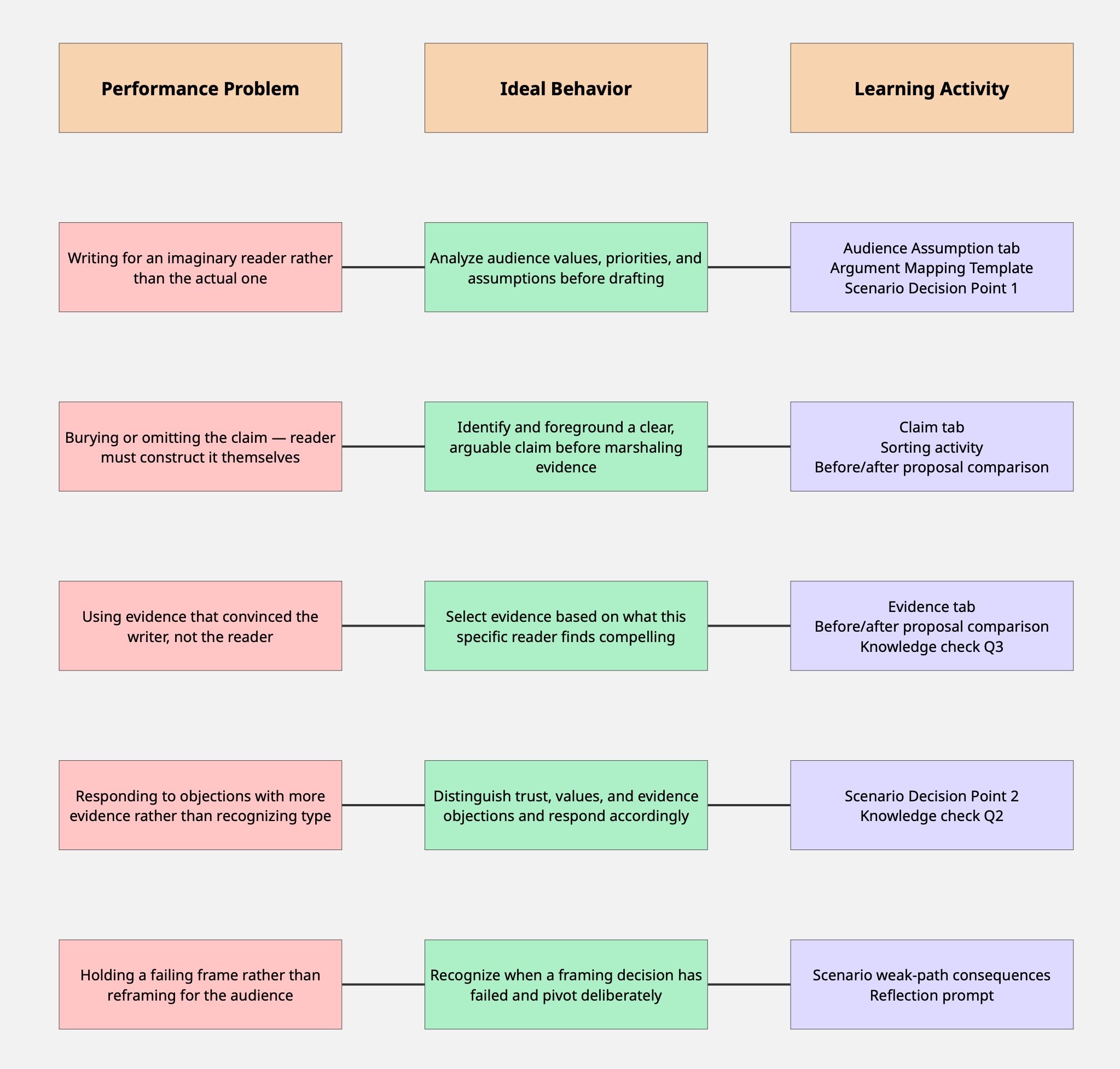
The action map below shows the relationship between performance problems, ideal behaviors, and learning activities:
Scenario Design
The branching scenario is the centerpiece of the module. Learners play the role of a communications consultant to Jordan, a nonprofit program director seeking legislative funding for an adult literacy initiative. The committee she is addressing is fiscally conservative and skeptical, reflecting what I view as a realistic and recognizable challenge in the nonprofit sector.
I scripted the scenario with the full branching architecture mapped on paper. It features:
Two decision points with three response options each
Nine distinct consequence screens
Three endings (full success, partial success, and failure)
The three-response structure is intended to keep learners engaged and motivated. Instead of a simple correct/incorrect binary (which has limited value), responses can be correct, partially correct, recoverable, and instructive. Every consequence screen pairs a narrative outcome with an italicized rhetorical principle, ensuring learners receive both experiential and analytical feedback at each branch. Consequences accumulate rather than converge so that sustained rhetorical judgment is rewarded across both decision points, not just at one.
I built the scenario in Articulate Rise 360's scenario block. It was designed for future embedding into a Storyline 360 build where the full branching architecture can be realized with greater interactivity and visual sophistication.
Content and Visual Design
Written content
I spent a lot of time developing the content before having it reviewed for accuracy and accessibility. I relied on research and my dual experience teaching rhetoric and editing documents to craft every piece of text. The problem statement situates the toolkit in real observed professional failures. The four knowledge check questions (with differentiated correct and incorrect feedback) were designed to assess application level learning consistent with Bloom’s revised taxonomy, presenting professional scenarios that require learners to apply the three-lens framework in context rather than recall its definitions. The action map connecting performance problems to learning activities was informed by Cathy Moore's action mapping methodology and adapted for a portfolio context.
The course is studded with relevant quotes from philosophers, literary scholars, and rhetoricians, all integrated at strategic points. Aware that quotes are often misattributed, I tracked each one to its source and verified them. Figures like Kenneth Burke, Lloyd Bitzer, Simone Weil, Aristotle, and Confucius intervene for three important reasons: they anchor the framework in its intellectual lineage, break up content-heavy blocks, and signal that the toolkit has genuine scholarly depth behind it. Female voices and voices from outside the Western canonical tradition were prioritized in the selection process.
The Argument Mapping Template
The downloadable Argument Mapping Template was developed as a standalone professional artifact alongside the course. A single-page pre-writing tool built around the three lenses and the classical rhetorical appeals (logos, ethos, pathos), it is designed for use before any high-stakes professional communication. It functions equally well as a course artifact and as an independent professional tool, extending the toolkit's reach beyond the eLearning environment to professionals who may never take the course itself.
Visual design
I decided on a clean, minimal aesthetic consistent with the course's intellectual rigor: generous white space, restrained typography, and professional imagery rather than generic corporate stock photography. My design philosophy prioritized legibility and intellectual seriousness over visual complexity, reflecting my belief that the framework's credibility rests on its intellectual content, not its surface appearance.
Extensions and Facilitated Delivery
Module 2: Interrogating the Frame
From the beginning, the toolkit was designed as a two-module series. Module 2 (Interrogating the Frame) has been fully scoped with a complete problem statement and a course outline. Where Module 1 teaches professionals to read and construct arguments, Module 2 teaches them to examine what arguments suppress, whose interests they foreground, and what they make impossible to think (especially in the absence of words to express it). A downloadable Frame Analysis Checklist is planned as the Module 2 toolkit artifact.
Facilitated Workshop Format
The three-lens framework, the Jordan scenario, and the Argument Mapping Template are easily modifiable for a half-day facilitated workshop for organizational delivery. The workshop format would replace the eLearning interactions with small group analysis of real professional documents drawn from participants' own organizations and experiences, making the rhetorical failures immediately visible and personally relevant. A consultant guide for facilitated delivery is planned as a third portfolio artifact.
Organizational Licensing
The toolkit's three delivery formats — a self-paced eLearning module, a facilitated workshop, and standalone downloadable artifacts — serve different organizational contexts and budgets. Policy teams and nonprofit leadership groups can access the framework through workshop delivery. Corporate L&D departments and academic writing programs can license the self-paced course for individual enrollment. The shared intellectual framework means the core content scales across all three without rebuilding from scratch.
Academic Adaptation
The framework's grounding in classical rhetoric and literary analysis makes it directly relevant for undergraduate and graduate writing courses in humanities, communications, and professional writing programs. To this end, I hope to expand the toolkit with theoretical scaffolding and longer reading assignments.
Reflection
The most significant conceptual challenge was distinguishing the classical rhetorical framework from the three practical lenses without creating cognitive overload for the learner. I decided to introduce the classical tradition as foundational context, then I positioned the lenses as a practical extension of it, returning to the classical framework only in the reflection section after the lenses have been fully internalized. This prevented the two frameworks from appearing as competing systems.
The branching scenario was the most demanding element to design well. I consulted other eLearning courses that featured similar interactions, noting their strengths and weaknesses. I also researched near-identical scenarios to create the most plausible consequences for each decision. Scripting accumulating consequences rather than convergent branches required sustained logical discipline — I needed to produce nine consequence screens, each specific to the path that led there, each consisting of both narrative and analytical feedback. My goal, ultimately, was to make every choice genuinely matter, which I find to be rare in professional eLearning.
As the first course I built, Reading the Room confirmed that a rigorous humanities-grounded framework can be translated into a professional eLearning experience with real-world applications. It also guided me in the design of subsequent courses, reminding me that the humanities are essential for helping us thrive in professional environments and in our personal lives. Such courses, I found, can be intellectually serious without being academically remote, practically grounded without being reductive.