Reading the Record: Historical Thinking for Professionals
Conceptual Development
History as the focus of a professional eLearning course? The skepticism ingrained in that question was the central challenge of designing this course. As with my other humanities-based courses, Reading the Record places a discipline at its center. Historical thinking (the method historians use to interrogate incomplete evidence, identify what shaped events, and construct defensible accounts of what happened and why) is one of the most analytically rigorous frameworks available to professionals. Oddly enough, as I found, it is also almost entirely absent from professional learning. My goal was to change that.
An early version of the course was oriented toward organizational memory, teaching learners to examine the stories their organizations tell about themselves. I discarded that framing in favor of something more ambitious: historical thinking as a portable analytical discipline that travels with learners across roles, organizations, and career stages. I chose the 1918 influenza pandemic as the historical anchor because every professional in my target audience had already lived through a version of it: COVID-19. Therefore, it wouldn’t feel distant. Learners would apply historical thinking to a past they participated in and may have misread.
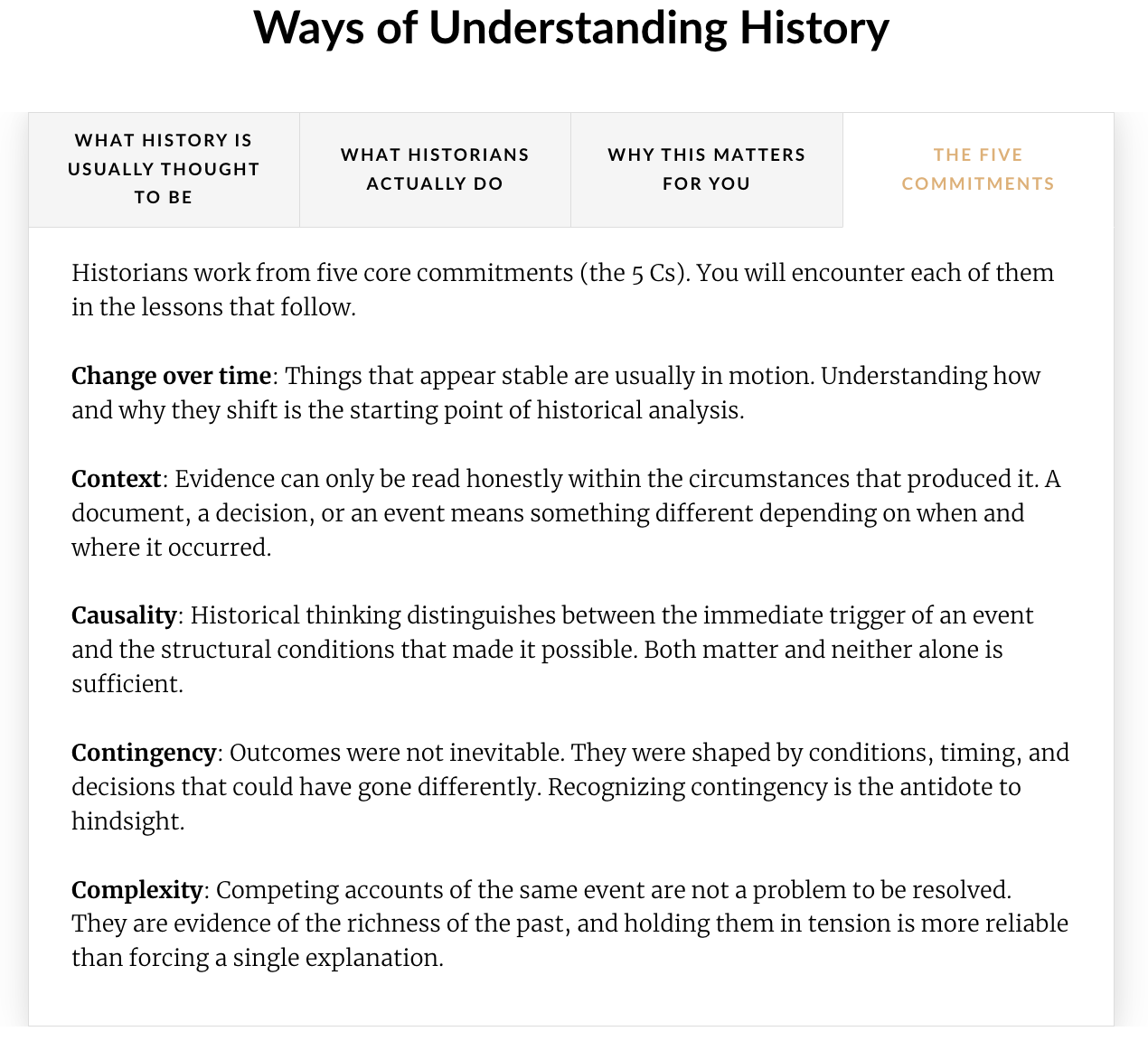
The course's intellectual foundation is the five core commitments of historical thinking: (1) change over time, (2) context, (3) causality, (4) contingency, and (5) complexity. These were drawn from Thomas Andrews and Flannery Burke's foundational work in the discipline and their 2007 article, “What Does It Mean to Think Historically?” As the heart of this course’s architecture, the commitments give learners a conceptual vocabulary they could name and carry beyond the course itself.
Instructional Design
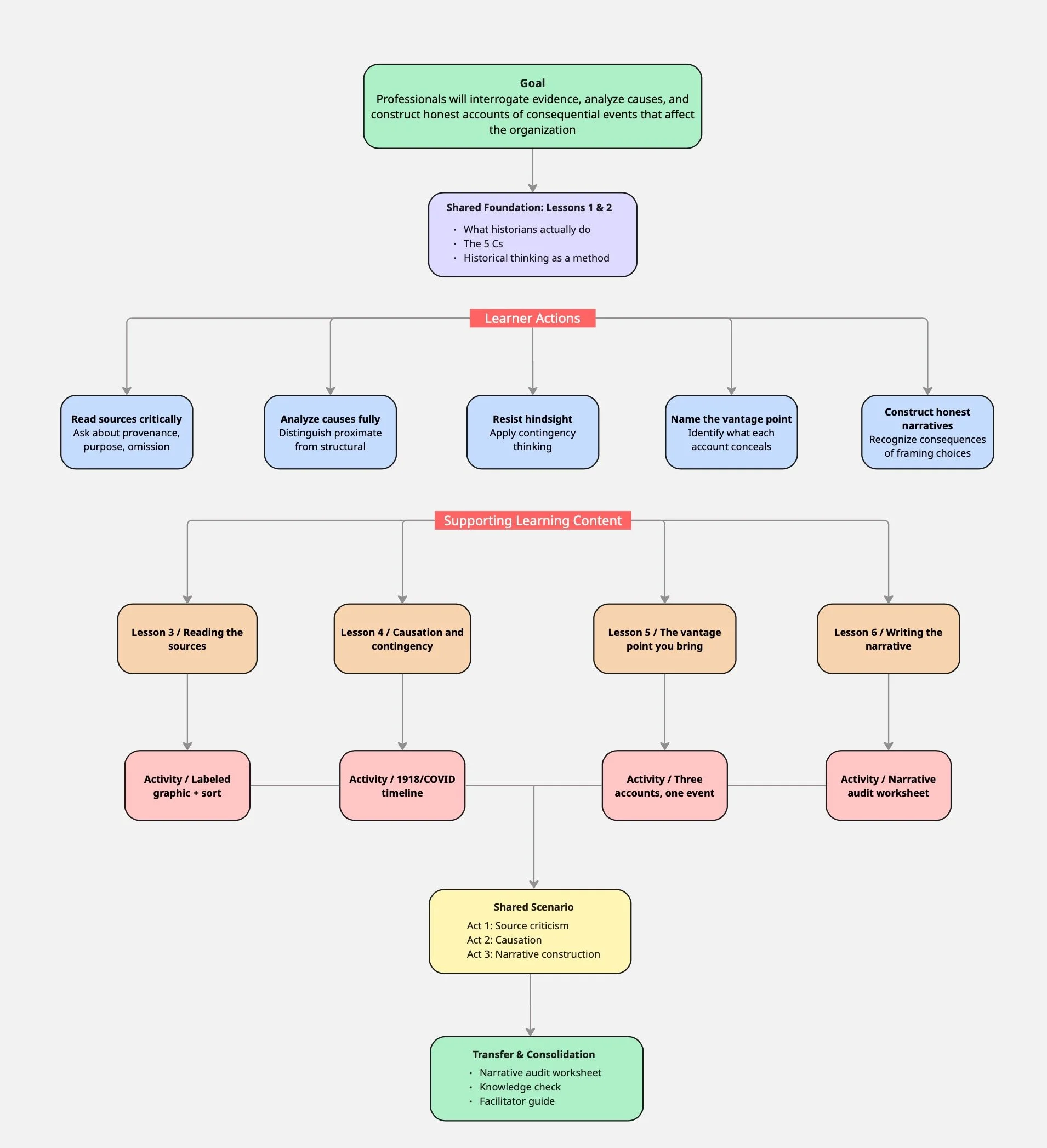
With the conceptual framework in place, I built the action map in accord with Cathy Moore's action mapping model, but now adapted to reflect the course's broader disciplinary goals. The map established the relationship between the business goal, the five performer actions the course needed to develop, and the learning content that would support each one. I also realized the branching scenario wasn't one lesson's activity, but a shared practice environment spanning three lessons simultaneously, each act applying a distinct analytical skill under narrative pressure.
Learning objectives came next. I learned that when objectives are written before the structure, they tend to describe the content you’re covering. Objectives written after describe genuine analytical goals. In the module, you notice the difference in the verbs selected: not identify and recall, but distinguish, analyze, recognize, and evaluate.
One small decision carried larger implications than expected. Early drafts used the word lens (standard in instructional design discourse) to describe the course's vantage point concept. I replaced it throughout with vantage point, a term that carries a stronger sense of orientation and implies both what can be seen and what falls outside the field of vision. It's more precise, more concrete, and more faithful to what the concept actually means, while also being distinct from the terminology used in Reading the Room.
Scenario Design
The branching scenario, as in my other courses, is the load-bearing structure of Reading the Record. I learned early on the value of building your centerpiece interaction first, then allowing the rest to follow from it.
My approach to scenario design is shaped by my literary training and study of narrative. Most instructional designers treat branching scenarios as logic problems: if this choice, then that consequence. I prefer to treat them as dramatic problems framed within a story arc.
The three-act structure follows classical dramatic architecture. Each act establishes a situation, creates tension through decision-making, and resolves with either a consequence or a move forward. The scenario as a whole moves from epistemological tension in Act 1 (what do we know, and how do we know it?) through analytical tension in Act 2 (what really caused this?) to ethical tension in Act 3 (what are we willing to record?). That progression mirrors the course's own arc from method to application to responsibility.
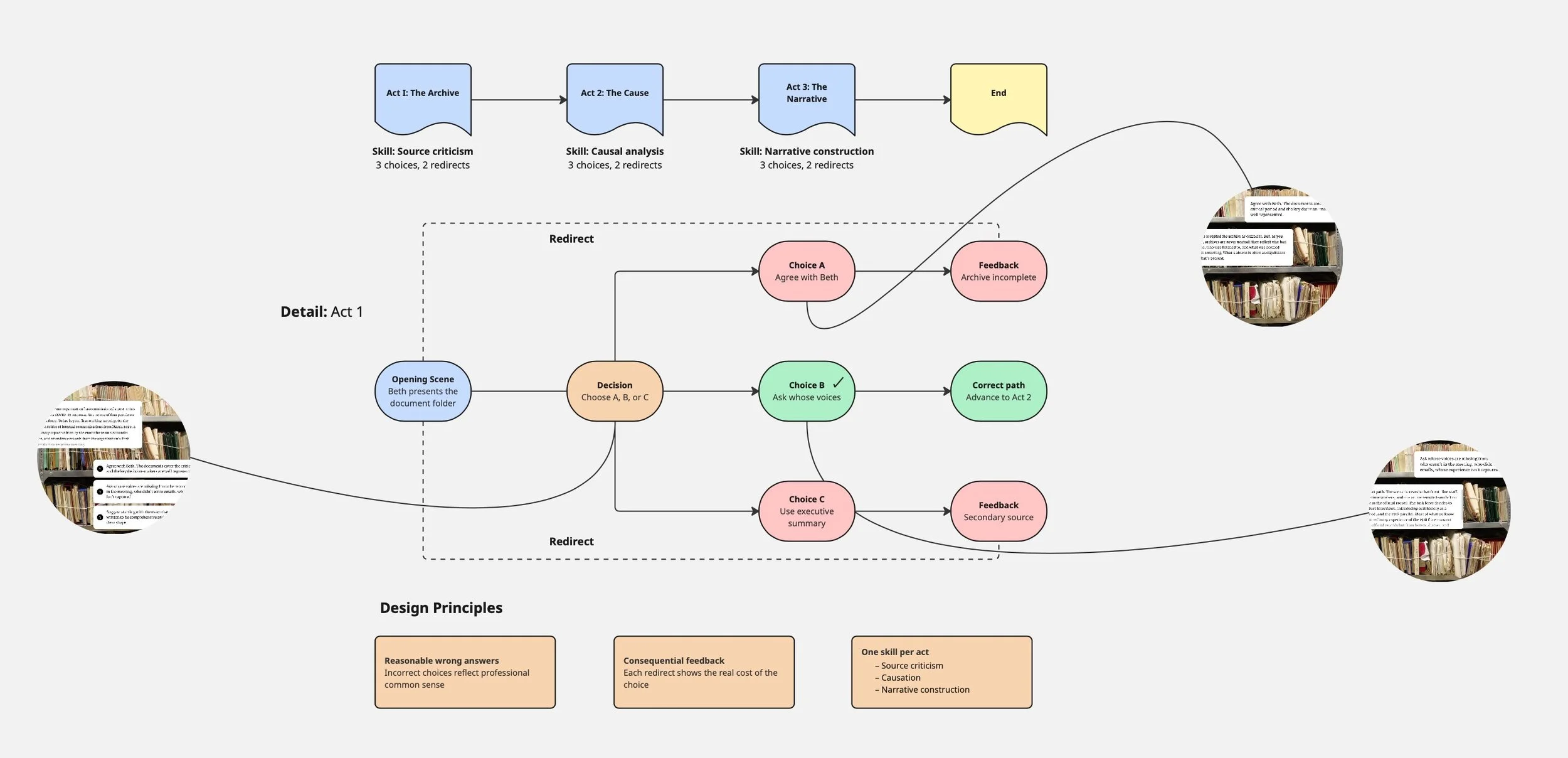
The characters were written as reasonable, well-intentioned people rather than obstacles or strawmen. Dana isn't careless; she's efficient. Marcus isn't lazy; he's reached a defensible conclusion from the available evidence. Patricia isn't corrupt; she's navigating legitimate competing pressures with real organizational stakes. These are round characters. What I hoped to make clear is that the most dangerous analytical failures feel like good judgment, therefore the wrong choices had to seem genuinely tempting.
Content and Visual Design
After the scenario, I built the surrounding seven lessons, moving from hook to method to application to synthesis to close. Every block type was chosen for a specific purpose: text blocks for conceptual introduction, tabs interactions for comparative analysis, a labeled graphic for source criticism in practice, a timeline for the 1918/COVID parallel, and reflection blocks throughout to activate prior knowledge and synthesize learning before the next section began.
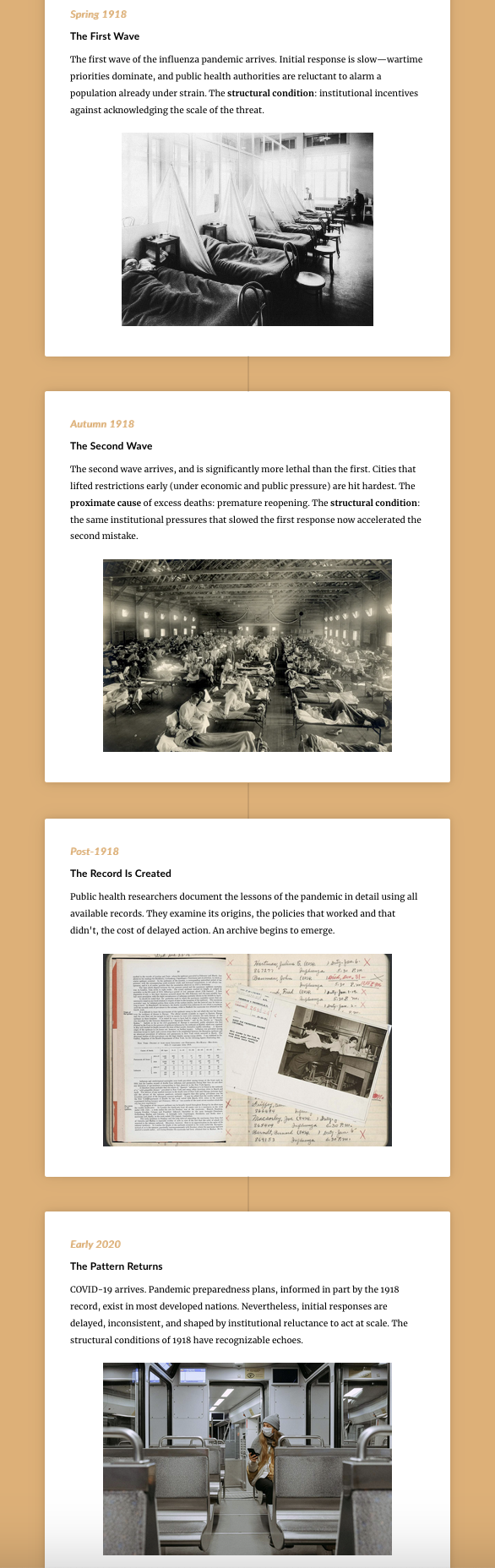
The sorting activity in Lesson 3 makes source criticism a physical act of categorization. The tabs in Lesson 5 force the learner to examine three competing accounts simultaneously before integrating them. The knowledge check questions are designed to reward genuine understanding rather than recall. In the latter, each wrong answer is plausible enough to attract a learner who absorbed the content without fully analyzing it.
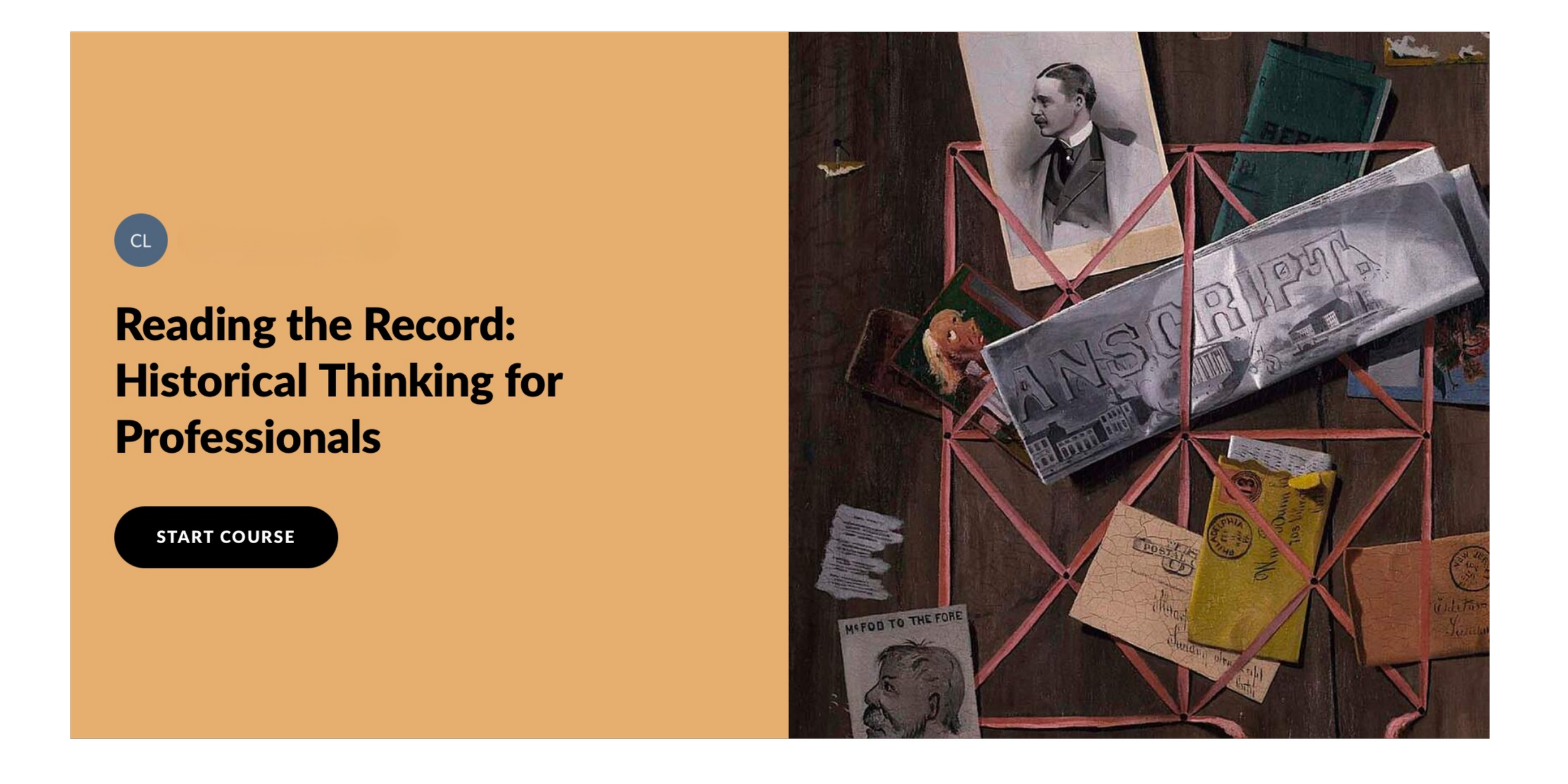
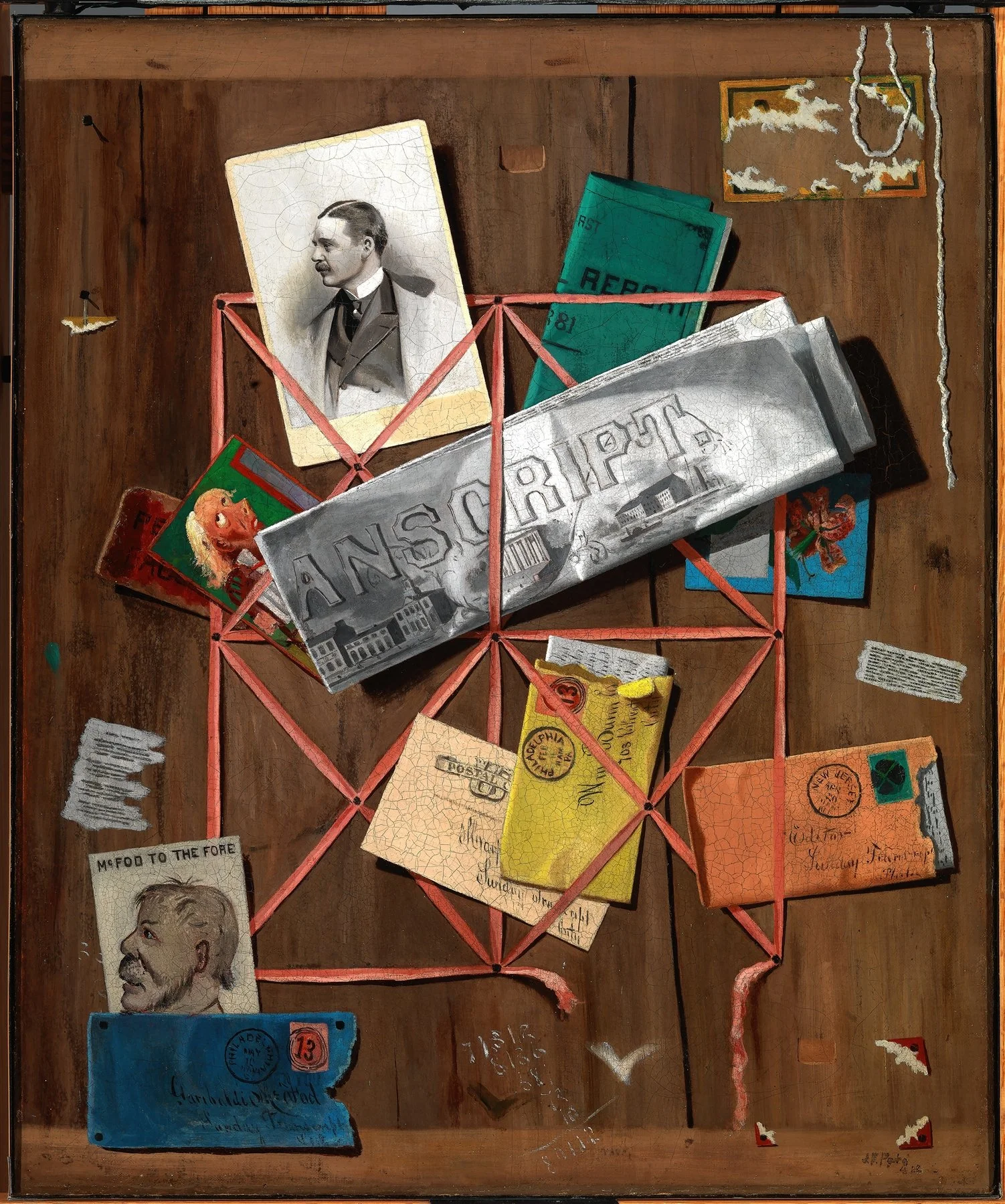
The course’s homepage features a work by John Frederick Peto, the 19th century American trompe l'oeil painter whose office board compositions depict letters, documents, receipts, and ephemera pinned in layered, overlapping disorder. Peto's paintings are literally about records, especially those that are incomplete, partially obscured, and reconstructable but never fully recoverable. Some images in the course are archival, showing aged documents, book shelves, and record offices. Others situate us in the period of the Spanish flu.
Extensions and Facilitated Delivery
The course was designed from the outset to extend beyond the Rise module. For example, the Narrative Audit worksheet offers learners six steps for applying the course's analytical tools to an episode in their own professional experience: (1) choosing a narrative, (2) examining its sources, (3) examining its causes, (4) identifying its vantage point, (5) analyzing what it does, and (6) asking the learner to consider their own role in maintaining or constructing this record.
The facilitator guide extends the course into a virtual half-day session for cohort-based delivery, with the Rise module as pre-work. Rather than re-teach the content, the session applies it and extends it through live document analysis, group revisitation of the scenario's decision points, and paired Narrative Audit conversations based on participants' own experience. It was designed on the premise that the facilitator's job is to create optimal conditions for thought, not to deliver the thinking on the group's behalf.
Reflection
Something I learned from my own coursework and the PD workshops I've attended (at least, the more effective ones) is that powerful courses can form habits of mind. Learning from the Record is designed to help learners navigate the unease arising from ambiguity: to teach them to no longer accept an incomplete account at face value, to ask whose voices are missing before accepting a record as complete, to look for structural conditions underneath the proximate cause, and to recognize that the narrative they're about to write (or construct in their minds) has significant implications.