When There’s No Right Answer: Ethical Reasoning for Professionals
Conceptual Development
Ethics courses can often take a prescriptive or normative approach to ethical dilemmas: do this, don’t do that. When There’s No Right Answer is intended to teach professionals how to think when the rules don't apply.
The course rests on both my study of ethics and a review of contemporary ethics workshops. What I came to learn is that real ethical conflict, in which two legitimate values are in tension (and every option costs something), is almost entirely absent from corporate training. What passes for ethics education is largely compliance training: reciting rules and acknowledging policies. Unfortunately, this only prepares professionals to avoid consequences, not to grapple with decisions.
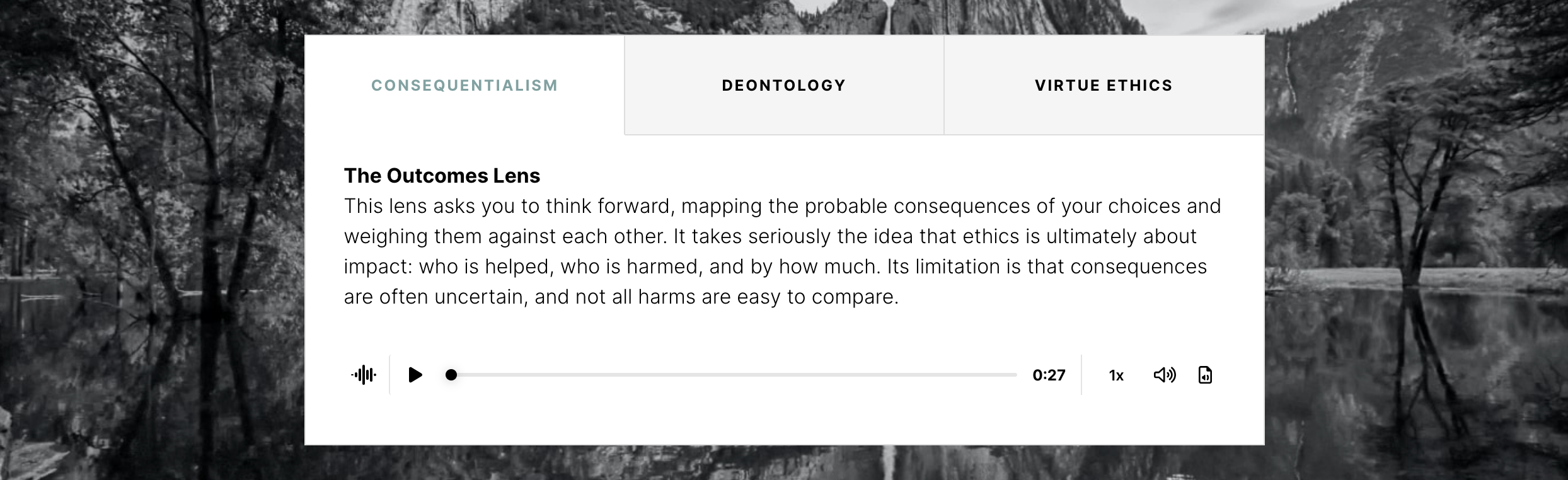
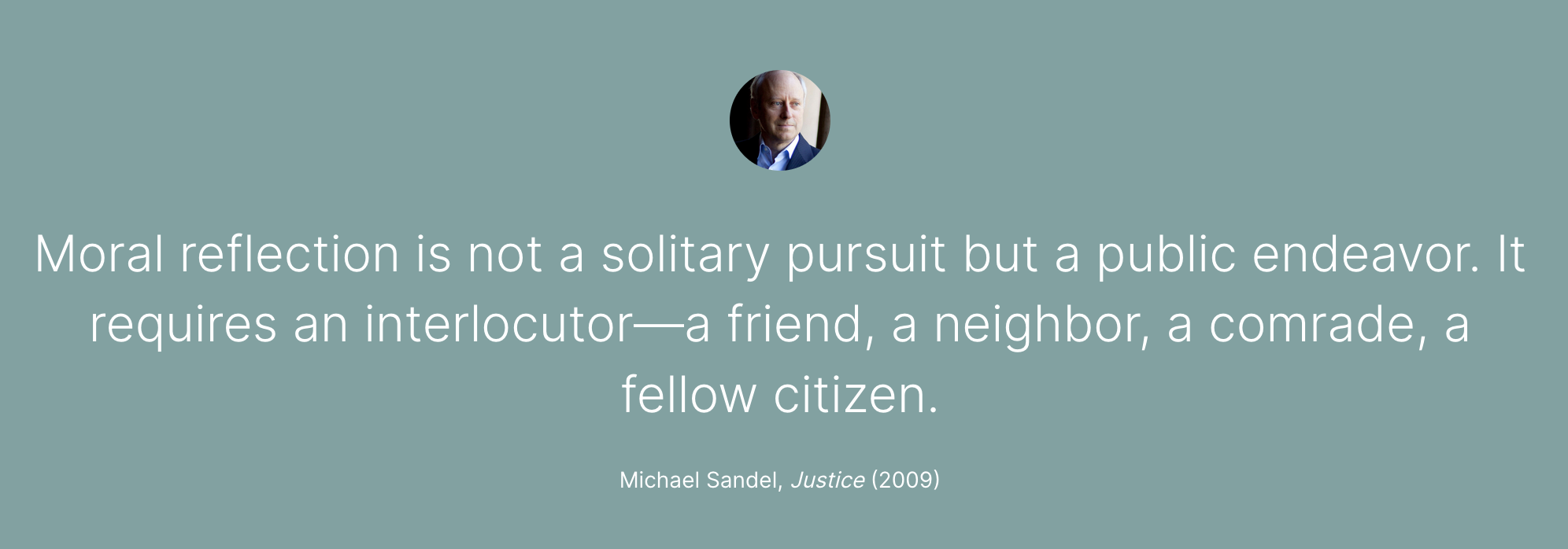
I’m an avid reader of the work of political philosopher Michael Sandel, whose central argument is that moral reasoning is a practice available to everyone. That principle shaped both the content and the pedagogical approach of this module. Drawing on the traditions of applied moral philosophy, including consequentialism, deontology, and virtue ethics, When There’s No Right Answer introduces these frameworks not as competing doctrines but as viewpoints for examining hard situations.
The central design question was: what does a professional actually need in order to reason well through ethical conflict? The answer shaped everything that followed.
Instructional Design
I designed the course around three core deliverables: a framework for thinking, a practiced skill, and a lens for evaluating professional situations. Five of Bloom’s cognitive skill levels informed the course’s learning objectives:
Recognize genuine ethical dilemmas as distinct from risk, preference, or policy questions
Name the competing values or obligations at stake
Apply a structured reasoning process through ambiguity
Articulate the reasoning behind a choice in terms others can evaluate
Use a personal reasoning template as a practical tool in professional life
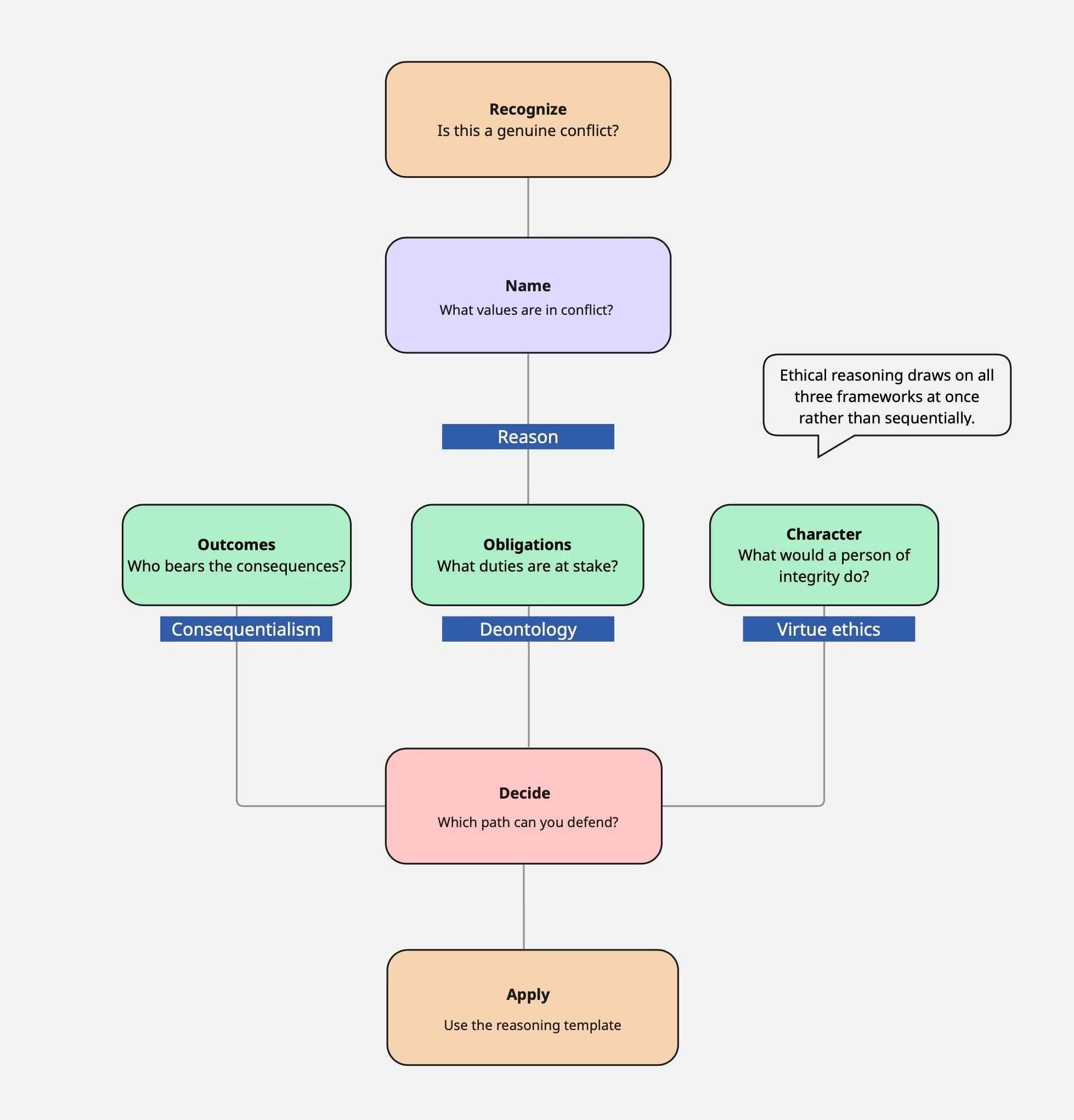
The instructional architecture follows a sequence of increasing complexity and engagement. Section 1 builds discernment, the ability to recognize what kind of situation you're actually in. Section 2 develops vocabulary, the values and frameworks needed to name the conflict. Section 3 applies both under pressure in a branching scenario. And Section 4 consolidates the learning into a personal tool.
The module runs approximately 90 minutes and is built in Rise 360. It is designed for self-paced learning and structured to support cohort-based facilitation when organizations want the fuller experience.
Scenario Design
The branching scenario, titled The Report, places the learner in the role of a mid-level manager at a professional services firm who has just completed a major internal audit. A respected supervisor asks him/her to reframe two damaging findings before the report reaches the executive team. The request is not to falsify anything, just to (A) soften the language, (B) bury one finding in an appendix, or (C) present another in a favorable light.

I designed the scenario with several principles in mind. First, no secret right answer. Each of the five paths through the scenario must be defensible, and the debrief must validate reasoning rather than reward a predetermined correct choice. Second, avoid dramatic whistleblowing territory. I wanted to foreground the kind of quiet, consequential moments that professionals actually face. Third, make the reasoning visible. Each debrief explains the specific values and philosophical frameworks at work in the learner's choice, making the implicit explicit.
The scenario architecture includes two decision points and five distinct paths: three primary (agree, push back, buy time) and three secondary within the buying time path (consult a peer, draft two versions, propose a compromise). Each path ends with a consequences screen and a debrief that names which values were followed, which were compromised, and which philosophical doctrine is most illuminating for that choice.
Content and Visual Design
I wanted to steer clear of corporate training conventions, which incline toward motivational framing and/or performative positivity. The module's tone is direct, intellectually serious, and addressed to the learner as a capable adult navigating genuinely difficult terrain.
As in Reading the Room and Reading the Record, I opted for a minimalist design with ample white space and carefully curated images. I used a sage green and white palette, and inserted verified quotes from primary sources (Sandel, Simone de Beauvoir, Iris Murdoch, Confucius) to highlight the framework’s intellectual lineage, break up content-heavy blocks, and emphasize the toolkit’s scholarly authority.
Two downloadable reference tools were designed in Microsoft Word to extend learning beyond the module: a Values Reference Card presenting the seven professional values most commonly in conflict, and a Personal Reasoning Template giving learners a five-step process for working through dilemmas in real time. I used Rise 360’s native block store with intention: Statement blocks for transitional moments, Accordion blocks for the four imposter categories, Tabs blocks for the three frameworks, and a dedicated scenario block for the branching activity.
Extensions and Facilitated Delivery
The module was designed to function at two levels: as a standalone self-paced resource and as the foundation for a richer cohort experience. For facilitated delivery, the Close includes a structured reflection prompt meant to stimulate group discussion: Think of a person in your professional life whose judgment you trust deeply. What is it about the way they navigate hard situations that earns that trust? And what would it look like for you to bring that same quality to the dilemmas you face?
The branching scenario offers particular value in facilitated contexts. Each path is defensible, therefore cohort members can debrief about which path they chose and why, allowing for constructive disagreement about values. I minored in philosophy, however I don’t think it’s necessary that facilitators have a philosophy background. The module's vocabulary and framework provide the structure. A planned extension will include additional branching scenarios with different value conflicts and professional contexts, a deeper treatment of each philosophical framework, a historical dimension examining how organizational culture shapes moral perception, and a capstone reflective assignment for cohort deployments.
Reflection
Recognizing a gap in professional ethics training, I knew I had a strong basis for this module. I wanted to design an eLearning experience that would teach ethical reasoning, not rules compliance. I also know that most professionals are not unethical, but they are likely under-equipped to handle real ethical conflicts. To design a course that takes that gap seriously, I had to resist a few conventional LxD impulses: to provide a correct answer, to resolve ambiguity too quickly, and to make the content feel manageable rather than genuinely challenging.
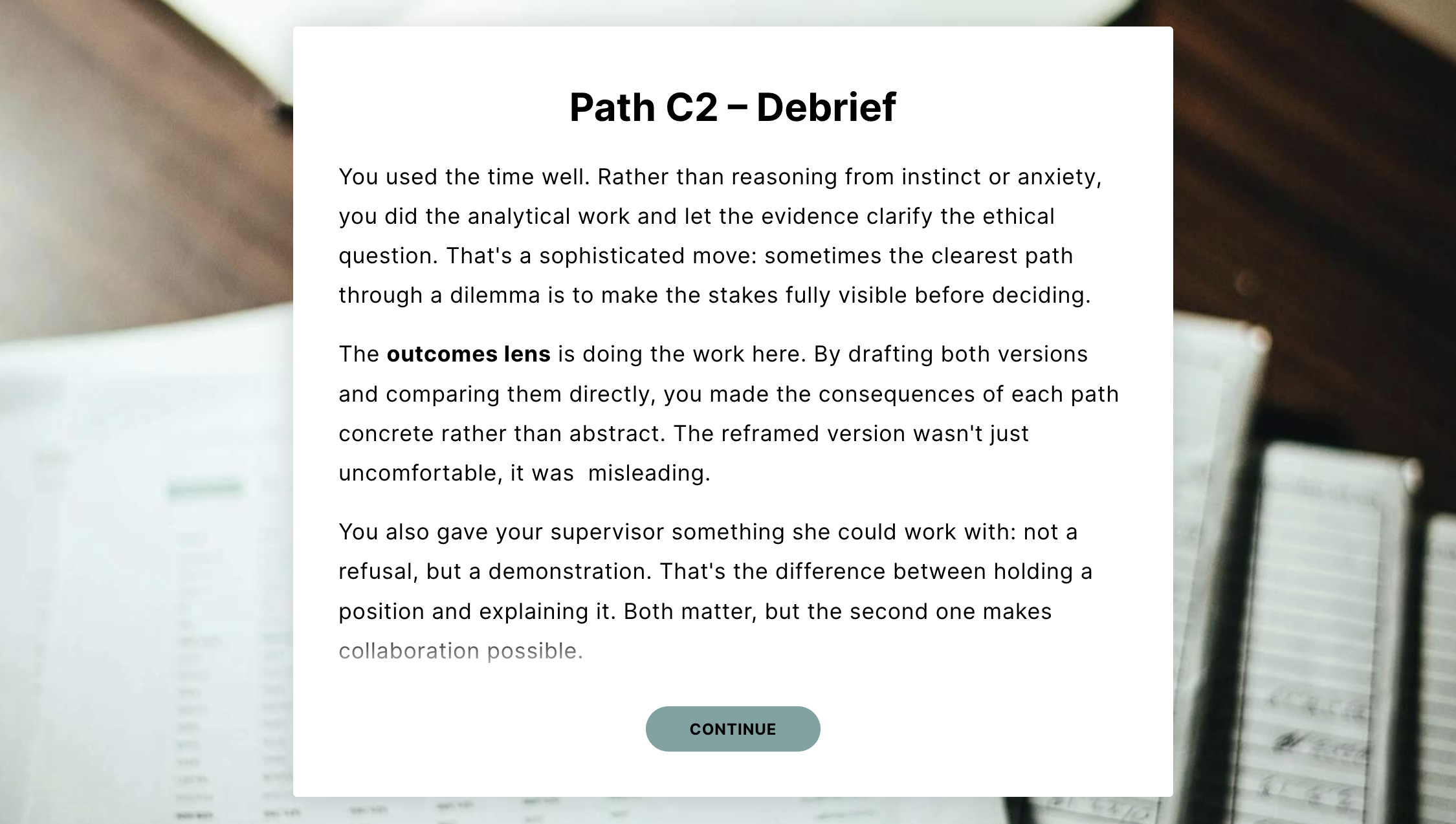
That meant not merely rewarding outcomes, but making ethical reasoning visible through every choice. For example, the debrief copy after each scenario path names what the learner was implicitly valuing, which frameworks were at work, and what the choice gave up. In metacognitive terms, learners could see not just what happened but why their reasoning led there, and that I hope is what separates this module from awareness-level ethics content. No Right Answer treats ethics not as a compliance requirement but as a human practice which can be taught, developed, and implemented in the most critical moments.